


Losing NCIC/III Access: The Operational Nightmare Every Chief Should Plan For

Ask a patrol officer to name the tools they can’t work without, and the radio comes up first. But running a close second — and often invisible until it’s gone — is access to NCIC and the Interstate Identification Index (III). Dozens of times a shift, your people query those systems: running a plate, checking for wants and warrants, verifying a stolen vehicle, confirming a protection order, identifying a subject who won’t give a straight name. It is woven into the fabric of the job.
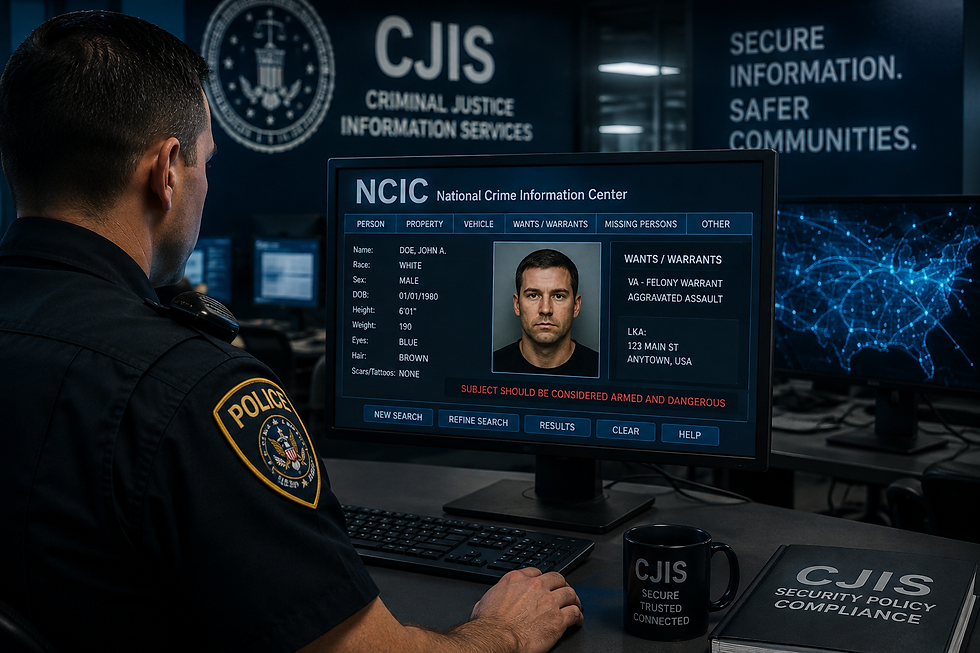
The system your agency can’t operate without
Now picture that access gone. After a serious compliance failure, a misuse case, or a breach, your State CJIS Systems Agency can suspend or terminate your agency’s access. The moment it does, your officers lose the ability to run those checks in the field. Dispatch can’t confirm a warrant before an arrest. Booking can’t verify an identity. Investigations that depend on III stall. This is not a slow degradation you manage around — it is an abrupt operational and officer-safety crisis.
And it does not come back with a phone call. Restoring access means remediating the underlying failure, proving that remediation to your CSA, and waiting for the decision. Days or weeks of degraded operations, with your people working blind in exactly the situations where information keeps them safe.
“Lose your NCIC access and you don’t lose a system — you lose the ability to keep officers safe and cases moving.”— Charles Denyer
The access is the agency’s — and so is the exposure
NCIC/III access is not a permanent entitlement. It is granted to your agency through your CSA under agreements your leadership signed, and it is conditioned on compliance with the FBI CJIS Security Policy. When that access is pulled, the fallout doesn’t land on the LASO or the IT vendor. It lands on the chief who has to tell a shift they’re running blind, and on the sheriff who has to explain to the county why.
The policy, in plain terms: Access to CJIS systems is bound by agreements that carry the standards, audits, and sanctions governing their use. The policy is explicit that misuse of criminal history record information and NCIC non-restricted files is serious and may result in administrative sanctions — “including, but not limited to, termination of services and state and federal criminal penalties.”CJIS Security Policy v6.0 (dated 12/27/2024), § 4.2.5.2, Penalties. “Termination of services” is the formal name for losing the access your agency runs on.
Read plainly: the authority that grants your access is the same authority that can take it away, and the trigger is your own compliance posture. That makes protecting access a leadership responsibility, not a technical footnote.
Access is conditional, and the condition is compliance
Your agency’s connection to NCIC and III runs through your CSA under the FBI CJIS Security Policy v6.0, dated December 27, 2024. The CSA audits your agency on a triennial cycle and holds the authority to escalate unresolved problems — up to and including suspension or termination of access. This isn’t a threat the state invented; it is the enforcement mechanism baked into the agreement that granted your access in the first place.
The enforcement landscape also hardened recently. As of October 1, 2024, the modernized Priority 1 requirements — alongside the long-standing requirements carried forward from prior versions — became the set that is auditable and sanctionable. An agency that has let those slide is no longer running a theoretical risk; it is carrying live exposure that an audit can convert into a finding, and a serious finding can convert into lost access.
What actually gets your access pulled
Access is rarely lost over a single paperwork slip. It is lost when a real problem goes unaddressed, or when misuse crosses a line the policy treats as serious. The recurring triggers:
Misuse of CJI. Running queries for non–criminal-justice purposes — personal curiosity, a favor, an off-book background check — is among the fastest routes to sanctions, because the policy names it explicitly.
A serious audit finding left unremediated. Findings are survivable; ignoring them is not. Uncorrected issues across cycles signal to your CSA that the agency can’t be trusted with the data.
A breach exposing CJI. A compromise of criminal justice information triggers reporting obligations and scrutiny that can put access under review.
Sanctionable requirements left unmet. Priority 1 items like multi-factor authentication are enforceable now; leaving them open is exactly the kind of gap an audit is built to catch.
No idea where you stand. The agencies most exposed are the ones that assume access is safe because it always has been — and discover otherwise mid-audit.
Every one of these is preventable. None of them announces itself before the day it matters.
How leadership keeps the lights on
Protecting access is about treating it as the mission-critical infrastructure it is. Four moves separate agencies that keep their connection from agencies that lose it:
Know your posture. Get an honest read on where compliance actually stands, so no finding surprises you.
Remediate fast. Close findings on a clock, and document the closure — unresolved issues are what escalate.
Enforce proper use. Train, monitor, and audit query activity so misuse never becomes the reason access is reviewed.
Plan for the worst. Have a continuity plan for degraded access, so a suspension is a managed event rather than a full-stop crisis.
If your team is ready to execute, the tools are already built. The CJIS Vault — the definitive CJIS Security Policy library, with 200+ deploy-ready assets — includes control-by-control CSA audit checklists, POA&M and gap-analysis trackers, and a full policy-and-SOP suite (including the proper-use and audit-logging procedures that keep misuse from becoming an access question). Learn more at cjisacademy.com.
Would your access survive an audit tomorrow?
Most agencies can’t answer that with confidence — and confidence, here, is the whole game. If you don’t know which findings an assessor would raise or which sanctionable requirements are open, you don’t actually know whether your access is secure. You’re assuming it is because it always has been, which is precisely the assumption that fails at the worst time.
The move that protects your operations is simple: find out where you stand while you still have room to fix it — not after a finding has already put your connection in question.
The bottom line
NCIC/III access is not a given; it is a privilege conditioned on compliance, granted and revocable through your CSA. Misuse, unremediated findings, breaches, and unmet Priority 1 requirements are the triggers that pull it — and when it’s gone, officer safety and daily operations degrade immediately, with no quick path to restoration. The agencies that never face that crisis are the ones that treated their access as mission-critical infrastructure and knew their posture before an auditor did. The first step is finding out exactly where you stand.
Book Your CJIS Discovery Session
Not sure whether your access would survive an audit? In a brief, no-obligation discovery session, Charles Denyer will help you cut through the uncertainty around CJIS v6.0 — getting you a clear, expert read on where your risk is concentrated and how to think about your path forward. It’s the fastest way to move from guessing to knowing, well before your next audit.
No obligation
About the Author — Charles Denyer | America’s Leading FBI CJIS Security Policy Expert

Charles Denyer is widely recognized as the nation’s foremost authority on the FBI CJIS Security Policy. For more than two decades, he has advised criminal justice agencies, state and local governments, private-sector providers, and technology vendors on implementing one of the nation’s most demanding criminal justice cybersecurity standards.
As Founder & CEO of CJIS Academy, Charles has developed the definitive library of FBI CJIS Security Policy documentation, implementation toolkits, training programs, and operational resources. He also provides expert consulting services, including CJIS readiness assessments, gap analyses, policy and procedure development, remediation planning, vendor compliance support, and audit preparation for agencies and organizations nationwide.
While best known for his work with the FBI CJIS Security Policy, Charles also brings extensive expertise in the NIST Risk Management Framework (RMF), DCSA/eMASS, FISMA, FedRAMP, DFARS, CMMC, ISO 27001, SOC 1/SOC 2, PCI DSS, GDPR, and other leading cybersecurity and compliance frameworks.
A published author, podcaster, and sought-after speaker on national security, cybersecurity, compliance, risk, and artificial intelligence, Charles serves clients nationwide and is based in Austin, Texas, and Los Angeles, California.
