What CJIS Non-Compliance Actually Costs a Criminal Justice Agency

Leaders often ask what CJIS non-compliance costs, expecting a number — a penalty on an invoice, a figure to put in a budget. That number doesn’t exist. And that is exactly what makes the real cost so easy to underestimate and so dangerous to ignore. CJIS non-compliance isn’t billed to you; it’s absorbed by you — in operational disruption, legal exposure, emergency spending, and reputational damage that no budget line ever anticipated.

There is no line item called “CJIS fine”
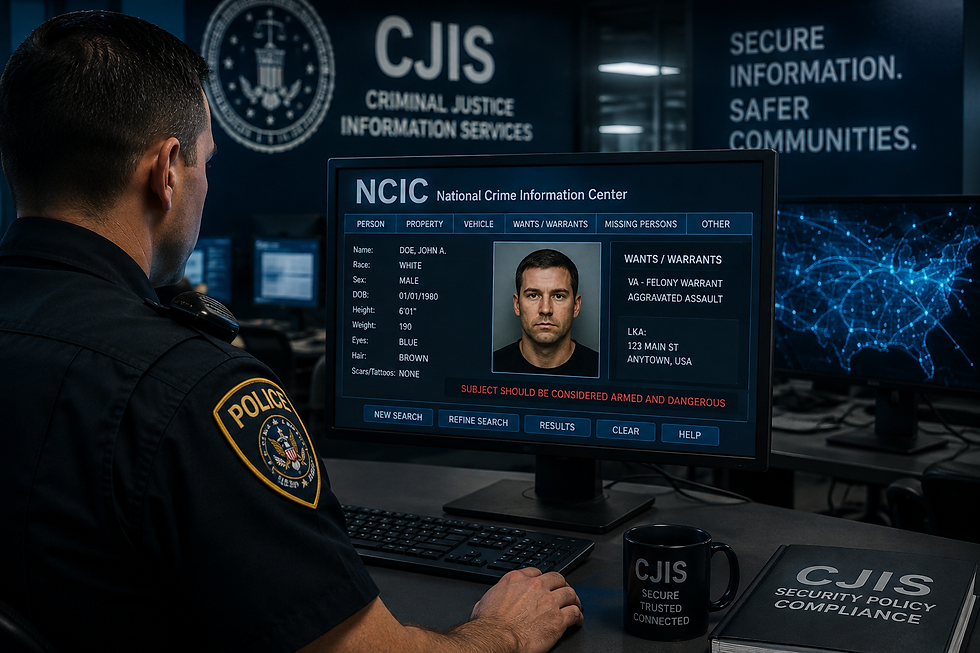
Consider what a single serious finding or breach actually sets in motion. Your access to NCIC and the Interstate Identification Index — the systems your deputies and officers rely on to run a plate at 2 a.m., confirm a warrant, or verify an identity at a traffic stop — can be curtailed or pulled. When that access goes, your agency doesn’t merely slow down; parts of it stop. Officer safety, case processing, booking, and dispatch all degrade at once, and there is no vendor you can call to restore it overnight.
Then come the bills nobody budgeted for: forensic investigation, breach notification, outside legal counsel, overtime, and the specialists brought in at emergency rates to do what routine compliance would have handled for a fraction of the cost. And finally, the cost that never appears on any spreadsheet — the sheriff or chief standing before the county commission, the press, and the public to explain how criminal justice information was lost on their watch.
“There’s no invoice for CJIS non-compliance. You pay it in lost access, lawsuits, and the public trust you can never buy back.”— Charles Denyer
Compliance is a command responsibility
It is tempting to file CJIS under “IT.” Your LASO manages the day-to-day, your vendors supply the systems, and the technical controls live in someone else’s job description. But accountability does not delegate the way tasks do. When your State CJIS Systems Agency issues a finding, when access is suspended, or when CJI is compromised, the questions travel to the top of the organization — not to the help desk.
This is by design. The agreements that grant your agency access to CJIS systems are executed at the executive level and bind the agency as a whole to the standards, audits, and sanctions that govern that access. Signing up for the data means signing up for the accountability.
The policy, in plain terms: The CJIS Security Policy is blunt about the consequences of getting this wrong. Improper access, use, or dissemination of criminal history record information and NCIC non-restricted files is treated as serious and may result in administrative sanctions — “including, but not limited to, termination of services and state and federal criminal penalties.”CJIS Security Policy v6.0 (dated 12/27/2024), § 4.2.5.2, Penalties. “Termination of services” means the loss of the CJIS access your agency runs on.
The practical translation is simple: the chief who treats CJIS as a purely technical matter inherits the consequences without the visibility to prevent them. The leaders who fare best are the ones who treat compliance as something they own.
One standard, enforced through your CSA
The FBI CJIS Security Policy v6.0, dated December 27, 2024, spans twenty distinct policy areas and defines the security requirements every agency that touches CJI must meet. To name only a handful: information exchange agreements, security awareness training, incident response, auditing and accountability, access control, identification and authentication, configuration management, media protection, physical protection, personnel security, systems and communications protection, formal audits, and mobile devices — and a great deal more. It is not aspirational guidance. It is enforced, and the enforcement path runs straight through your
State CJIS Systems Agency (CSA).
Your CSA audits your agency on a triennial cycle and can escalate findings all the way to the loss of CJIS access. That authority isn’t arbitrary — your access exists because your agency signed an agreement to conform to the policy, and that same agreement carries the audit and sanction provisions. Compliance is the condition of access, not a favor you do the state.
And the clock has already moved. As of October 1, 2024, the modernized Priority 1 requirements — alongside the long-standing requirements carried forward from prior versions — became the set that is auditable and sanctionable. Agencies that assumed v6.0 was a problem for later are already being measured against it today. At the leadership level, “compliant” no longer means a binder on a shelf; it means a funded, owned, continuously maintained program that can produce evidence on demand.
The gaps that quietly become findings
The most expensive words in CJIS compliance are “we passed last time.” A clean audit three years ago tells you almost nothing about a v6.0 audit today — the standard changed, your systems changed, and your vendors changed. These are the exposures we see most often, and each one stays invisible right up until it isn’t:
No current map of where CJI actually lives. Records systems, cloud backups, body-camera footage, shared drives, vendor platforms — if leadership can’t say where CJI resides, no one can protect all of it.
Unvetted vendors and cloud services touching CJI. Every provider that stores, transmits, or can access your CJI is inside your compliance boundary — and their failure becomes your finding.
Sanctionable requirements left unmet. Multi-factor authentication is a Priority 1 requirement and is enforceable now; long-standing requirements like validated encryption, carried forward from prior versions, remain enforceable as well. Many agencies still haven’t met them.
A compliance function resting on one person. If your entire CJIS program lives in your LASO’s head, a single resignation is an existential risk.
Treating the audit as paperwork. Assembling evidence the week before an assessment produces theater, not readiness — and experienced auditors know the difference on sight.
The through-line: none of these feel urgent until they surface as a finding, a breach, or a suspension notice. That is precisely why they persist — and why the agencies carrying them rarely know it.
What leadership actually owns
The fix isn’t a purchase; it’s a posture. At the decision-maker level, four things separate the agencies that pass from the agencies that scramble:
Know where your CJI lives. Maintain a current inventory as a standing leadership artifact, not an IT afterthought.
Fund and own the program. Name an accountable owner, give them real budget and authority, and treat compliance as continuous operations.
Close Priority 1 first. Direct resources to the requirements that are sanctionable now, before the ones that aren’t yet.
Hold the boundary. Require every vendor that touches CJI to meet the standard and prove it, in writing.
If your team is ready to execute, the tools are already built. The CJIS Vault — the definitive CJIS Security Policy library, with 200+ deploy-ready assets — includes control-by-control CSA audit checklists, POA&M and gap-analysis trackers, and a full policy-and-SOP suite covering all 20 policy areas. Learn more at cjisacademy.com.
You can’t defend what you haven’t measured
Every cost above shares one root: it is far cheaper to know than to find out. An agency that has honestly measured its exposure can budget for it, prioritize it, and defend it to elected officials with confidence. An agency that hasn’t is making decisions blind — and usually learns the truth at the worst possible moment, when an auditor or an attacker measures it first.
The single most valuable move a leader can make is to get an objective, outside read on where the agency actually stands — before someone else provides one for you.
The bottom line
CJIS non-compliance has no tidy price tag, which is exactly why it’s underestimated. The real costs — lost NCIC access, legal liability, emergency spending, and public trust — land squarely on the agency’s leadership. The standard is v6.0, it’s enforced through your CSA, and its Priority 1 requirements are sanctionable now. The question was never whether you can afford to get compliant. It’s whether you can afford to discover the cost of non-compliance the hard way — and that starts with knowing exactly where you stand.
Book Your CJIS Discovery Session
Not sure where your agency truly stands? In a brief, no-obligation discovery session, Charles Denyer will help you cut through the uncertainty around CJIS v6.0 — getting you a clear, expert read on where your risk is concentrated and how to think about your path forward. It’s the fastest way to move from guessing to knowing, well before your next audit.
No obligation
About the Author — Charles Denyer | America’s Leading FBI CJIS Security Policy Expert

Charles Denyer is widely recognized as the nation’s foremost authority on the FBI CJIS Security Policy. For more than two decades, he has advised criminal justice agencies, state and local governments, private-sector providers, and technology vendors on implementing one of the nation’s most demanding criminal justice cybersecurity standards.
As Founder & CEO of CJIS Academy, Charles has developed the definitive library of FBI CJIS Security Policy documentation, implementation toolkits, training programs, and operational resources. He also provides expert consulting services, including CJIS readiness assessments, gap analyses, policy and procedure development, remediation planning, vendor compliance support, and audit preparation for agencies and organizations nationwide.
While best known for his work with the FBI CJIS Security Policy, Charles also brings extensive expertise in the NIST Risk Management Framework (RMF), DCSA/eMASS, FISMA, FedRAMP, DFARS, CMMC, ISO 27001, SOC 1/SOC 2, PCI DSS, GDPR, and other leading cybersecurity and compliance frameworks.
A published author, podcaster, and sought-after speaker on national security, cybersecurity, compliance, risk, and artificial intelligence, Charles serves clients nationwide and is based in Austin, Texas, and Los Angeles, California.